
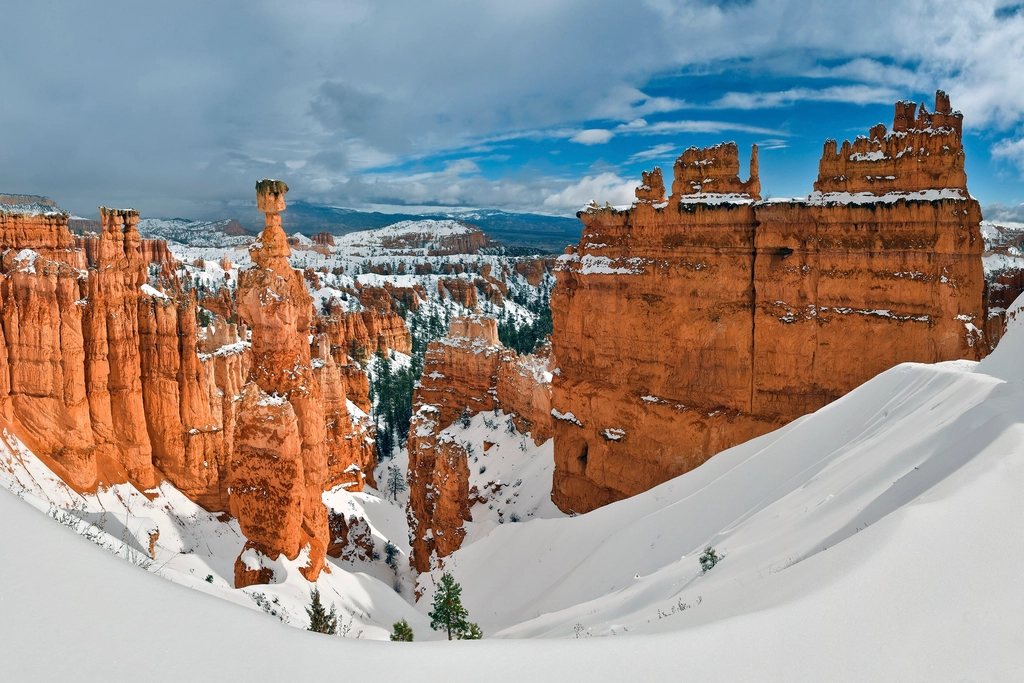
People ask us when to visit southern Utah as if there were a single right answer, and we always want to reply with a question: which southern Utah? The rim of Bryce Canyon sits at 8,000 to 9,100 feet (2,400 to 2,780 m) and has snow on the ground for half the year. The floor of Zion Canyon, at about 4,000 feet (1,200 m), bakes past 100 F (38 C) in July. Capitol Reef and the Escalante country lie in between. The seasons arrive in each place at different times and with different tempers, and the trick of a good trip is to move between them.
Table of Contents
Winter: snow on the hoodoos
Bryce in winter is, for us, the best-kept open secret in the region. The rim collects well over 6 feet (2 m) of snow in an average year, and the park counts something like 200 nights a year with frost, which is exactly why the hoodoos exist: water freezes in the cracks, expands, and pries the rock apart a little more each cycle. Between storms the sky is a hard, cloudless blue, the amphitheatre is white and orange, and the viewpoints are nearly empty. The main road is ploughed to the principal overlooks; the southern stretch to the highest points is often closed after heavy snowfall. The paved rim between Sunset and Sunrise Points is walkable with traction spikes, and the trails into the amphitheatre are open or closed on the day depending on ice; one section of the Navajo Loop is routinely shut in winter for rockfall and ice, and you should expect that.
The cost is cold. Daytime highs hover in the 30s F (around 0 C), nights drop well below 10 F (minus 12 C), and many businesses near the rim close or run reduced hours. Zion, meanwhile, is mild: highs in the 50s F (10 to 15 C), the shuttle parked for the season so you can drive the canyon yourself, and a few short walks with ice on them. A winter week that pairs three days in Zion with two at Bryce is quiet, cheap and beautiful.
Spring: wind, mud and the long wait for the snow to leave
Spring is the season that surprises people most. Zion wakes early, with cottonwoods leafing out in April and the river running high and cold with snowmelt, which closes the walk up the narrows for weeks at a time. Bryce lags a full month or more behind; snow lingers on north-facing trail sections into May, the melt turns the tracks to red mud, and a storm can drop fresh snow on the rim in the middle of the month without anybody local finding it remarkable.
The constant is wind. March through May the plateaus catch fronts sweeping in from the west, and afternoons can be gritty, dusty affairs that make the rim unpleasant and the low country a sandstorm. Mornings are usually calm. Plan the exposed walks early, and keep a windproof layer at the top of the bag. The reward is water: waterfalls in Zion that are dry by July, wildflowers in the lower desert from late March, and at Capitol Reef, orchard blossom in April.
Summer: heat below, storms above
By June the low country is hot in earnest, and by July it is dangerous for anyone walking exposed trails after ten in the morning. The rule in Zion is to be on the trail at first light and off it by noon, then spend the afternoon in the river or in the shade. Bryce, by contrast, is glorious: highs around 80 F (27 C), cool nights in the 40s F (5 to 10 C), long evenings on the rim. It is also busiest now, with the amphitheatre viewpoints full from mid-morning and the park shuttle earning its keep.
From mid-July into September the monsoon arrives. Moist air pushes up from the south, afternoon cumulus builds over the plateaus, and thunderstorms roll through with lightning, hail and brief, violent rain. Two things follow. On the rim, get below the skyline when the clouds darken; lightning strikes viewpoints. In the canyons, never enter a slot or a narrows when rain is forecast anywhere upstream; flash floods arrive from storms you cannot see, and every summer someone learns that too late. The storms are usually over by evening, and the light afterwards, with wet rock steaming and rainbows over the hoodoos, is the best of the year.
Autumn: the light and the leaves
If we could only come once, it would be the first half of October. The monsoon has withdrawn, the air is dry and still, the days at Bryce are in the 60s F (15 to 20 C) and the nights just touch freezing. The aspens on the high plateaus turn gold in the last week of September and the first of October; the cottonwoods along the Virgin River in Zion follow a month later, peaking around the end of October and into early November. The low sun stays warm and orange for hours in the morning and evening, which is what every photograph of the amphitheatre you have ever admired was waiting for.
Autumn is not a secret. Zion in October is as full as in June, and beds within an hour of either park are booked months ahead. The consolation is that the days are shorter and the crowds thinner at either end, and that the first snowfall, which can arrive at Bryce any time from mid-October, sends most people home a week before the weather really turns.
Putting the calendar together
A rough rule for choosing dates, park by park:
- Bryce: best from late May to mid-October; superb but cold and partly closed December to March; unpredictable in April and early May.
- Zion: best in April, May, October and early November; workable in winter; punishing in July and August unless you rise before the sun.
- Capitol Reef and Escalante: best in April to early June and mid-September to October; too hot for long walks in high summer; icy back roads in winter.
Whenever you come, pack for two seasons at once. A day that begins at 28 F (minus 2 C) on the Bryce rim can end at 85 F (29 C) in a canyon three hours away, and the same is true in reverse. The people who look most comfortable on the trail are the ones with a fleece and a sun hat in the same bag.