
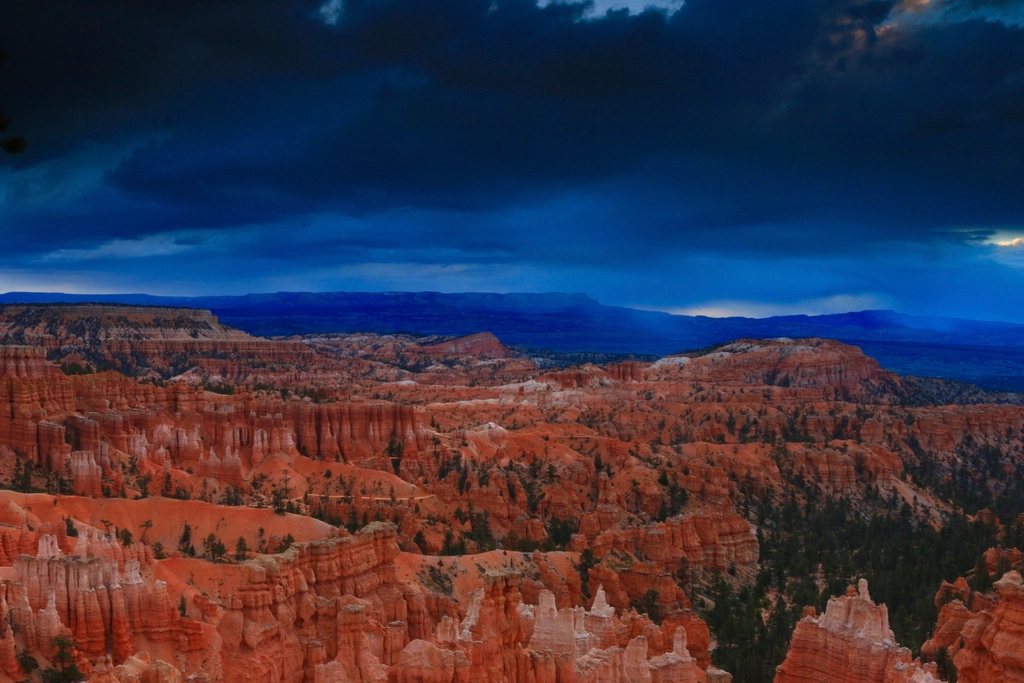
Bryce Canyon is one of the easiest places in the world to take a striking photograph and one of the hardest to take a good one. The hoodoos are so photogenic that almost any frame works, which is exactly why so many look the same. This is our honest guide to the light, the viewpoints and the moments that matter, and to what your phone will and will not manage once the sun goes down.
Table of Contents
Why the amphitheatre faces the morning
The main Bryce Amphitheatre is a bowl carved into the eastern edge of the Paunsaugunt Plateau. Every major viewpoint on the rim looks east or southeast. That single fact governs the light. At sunrise the sun comes up over the Paria Valley and hits the hoodoos head-on, lighting their faces in orange and pink while the sky behind them turns pale. At sunset the sun is behind you, and the hoodoos are lit from the back and side, with the shadow of the rim creeping across the bowl.
Both are worth shooting, but they are different pictures. Sunrise is the classic postcard: saturated rock, deep shadows between fins, a clean gradient in the sky. Sunset is more subtle: warm light rakes the tops of the formations, the valley behind glows, and the last minutes before the shadow swallows everything can be the best of the day.
The viewpoints and what each gives you
Sunrise Point, despite its name, is not the only place to watch the sunrise, and Sunset Point is often better for it. Sunset Point overlooks Thor’s Hammer and the tightly packed hoodoos of the Silent City, and at first light the entire wall in front of you ignites. Sunrise Point, a short walk north along the rim, gives a wider, gentler view with the Queen’s Garden below. Inspiration Point, higher and farther south, is where you go for the big panorama and for the layered fins of the Silent City as the light moves across them.
Bryce Point at 8,300 feet (2,530 metres) is the highest and offers the widest sweep of the amphitheatre; it is our favourite for sunset, since the whole bowl is in front of you and the shadow line is dramatic. Farther south, Rainbow Point at 9,115 feet (2,778 metres) looks out over the Grand Staircase, with the pink cliffs and distant Navajo Mountain 60 miles (97 kilometres) away visible on a clear evening.
The hours that matter
The best light at Bryce lasts about forty minutes on either side of sunrise and sunset. Arrive at least half an hour early. In summer that means being on the rim by 5:30 a.m.; in winter, closer to 7:15 a.m. The moment the sun’s edge appears the hoodoos flare, and within twenty minutes the light flattens. At the other end of the day, the last ten minutes before the sun drops behind the plateau are the richest, followed by a long, soft glow that many people leave too early to see.
- Golden hour: the first and last hour of direct sun, low and warm. The safest bet for phones and cameras alike.
- Blue hour: the twenty to thirty minutes after sunset (and before sunrise) when the sky is deep blue and the rock still holds a faint glow. Quiet, moody, underrated.
- Midday: harsh and flat, with the hoodoos casting almost no shadow. Better spent on the trails below the rim, where the walls provide their own shade and colour.
- Storm light: after a summer thunderstorm, when clouds break and light spills through gaps, the amphitheatre can be spectacular for a few minutes at a time.
Going below the rim
The pictures that look different from everyone else’s are usually taken from inside the amphitheatre. The Navajo Loop, 1.3 miles (2.1 kilometres) with about 550 feet (170 metres) of descent, drops through the Wall Street section between sheer fins that turn orange as the sun reaches into them mid-morning. The Queen’s Garden trail, 1.8 miles (2.9 kilometres), passes among individual hoodoos you can photograph at eye level. Combined as a figure-eight with the rim trail, the two make a 2.9-mile (4.7-kilometre) loop that is the park’s most rewarding short hike for a camera.
Light inside the bowl arrives late and leaves early, so a morning descent between 8 and 10 a.m. gives the best mix of sun and shadow. Note that Wall Street is usually closed in winter and early spring because of falling ice and rock.
What a phone can and cannot do
Modern phone cameras are genuinely good in daylight. At sunrise and sunset, the main things to control are exposure and colour. Tap the brightest part of the scene and drag the exposure down a little so the rock does not blow out; the phone’s automatic processing tends to over-brighten the hoodoos and turn them a lurid orange. If your phone has a “natural” or “standard” colour mode, use it, and avoid any saturation boost. Turn off the wide-angle lens for the classic frames; its distortion bends the horizon and shrinks the hoodoos.
After dark, the honest answer is that a phone has limits. Night modes can produce a surprisingly clear Milky Way from a phone braced on a rock or a small tripod, but expect a soft, noisy image that looks fine on a screen and falls apart when enlarged. Star trails, foreground detail and sharp individual stars are beyond most phones without a dedicated app and a tripod. A basic interchangeable-lens camera with a wide lens, a tripod and a 15-second exposure at high ISO will beat any phone for night work, but for the memory rather than the print, a braced phone at Inspiration Point will still give you something you are glad to have.
Small habits that make better pictures
Include something for scale: a single juniper on the rim, a person on the trail below, the thin line of the Navajo Loop switchbacks. Shoot vertically at least half the time; hoodoos are tall and the panorama habit wastes them. Wait for cloud shadows to move across the bowl rather than shooting the first frame. And put the phone down for at least a few minutes at each stop. The light at Bryce moves fast, and the best of it is often the part you were not photographing.