
The busiest hours for wildlife at Bryce Canyon are the ones most visitors spend asleep or at dinner. In the half-light before sunrise and the hour after sunset, the meadows along the park road fill with animals that were invisible at noon. This is a guide to who lives on the plateau, when and where to look, and how to watch without doing harm.
Table of Contents
The plateau as habitat
Bryce is not only the amphitheatre. Behind the rim the Paunsaugunt Plateau rolls south for 18 miles (29 kilometres) along the scenic drive, rising from ponderosa pine forest at 8,000 feet (2,400 metres) to spruce, fir and bristlecone at over 9,000 feet (2,745 metres). Between the trees lie open sagebrush meadows, the most important habitat in the park for the animals people most want to see. The park counts roughly 60 mammal species and more than 200 birds, but a handful of them define the experience.
Utah prairie dog: the plateau’s own species
The Utah prairie dog lives nowhere on earth except southwestern Utah, and Bryce Canyon holds one of its healthiest populations. It is a federally listed threatened species, a stocky, cinnamon-coloured rodent about a foot (30 centimetres) long that lives in colonies of burrows in the meadows near the visitor centre, along the road toward Sunset Point and in the grassland at the park’s northern edge. Their towns are easy to spot: mounds of bare earth, sentries standing upright, a chorus of sharp barks when anything approaches.
They are strictly daytime animals, most active in the cool of the morning and again in late afternoon, and they retreat underground in the heat of a summer midday. They hibernate from roughly October or November to March or April, so a winter visit will not find them. The best viewing is from a car window or from the road shoulder at a distance; walking into a colony sends every animal below ground and stresses a population that has been rebuilt with real effort. Feeding them is illegal and harmful.
Pronghorn: the fastest animal on the continent
Pronghorn are the tan-and-white antelope-like animals you may see in the meadows along the scenic drive and in the open country north and east of the park. They were reintroduced to the plateau in the 1980s after being absent for decades, and the herd now numbers in the dozens. They are the fastest land animals in North America, capable of bursts above 55 miles per hour (88 kilometres per hour) and, more remarkably, of sustaining 30 miles per hour for miles at a time, a speed evolved to escape a cheetah that vanished from this continent ten thousand years ago.
Look for them at dawn in the meadows between the park entrance and the Sunset Point turnoff, and in the wide sage flats south toward Rainbow Point. They are wary and have eyesight compared to eight-power binoculars, so a pronghorn will usually see you long before you see it. A slow car stopped on the shoulder with the engine off is the best blind you have.
Mule deer: everywhere, especially on the road
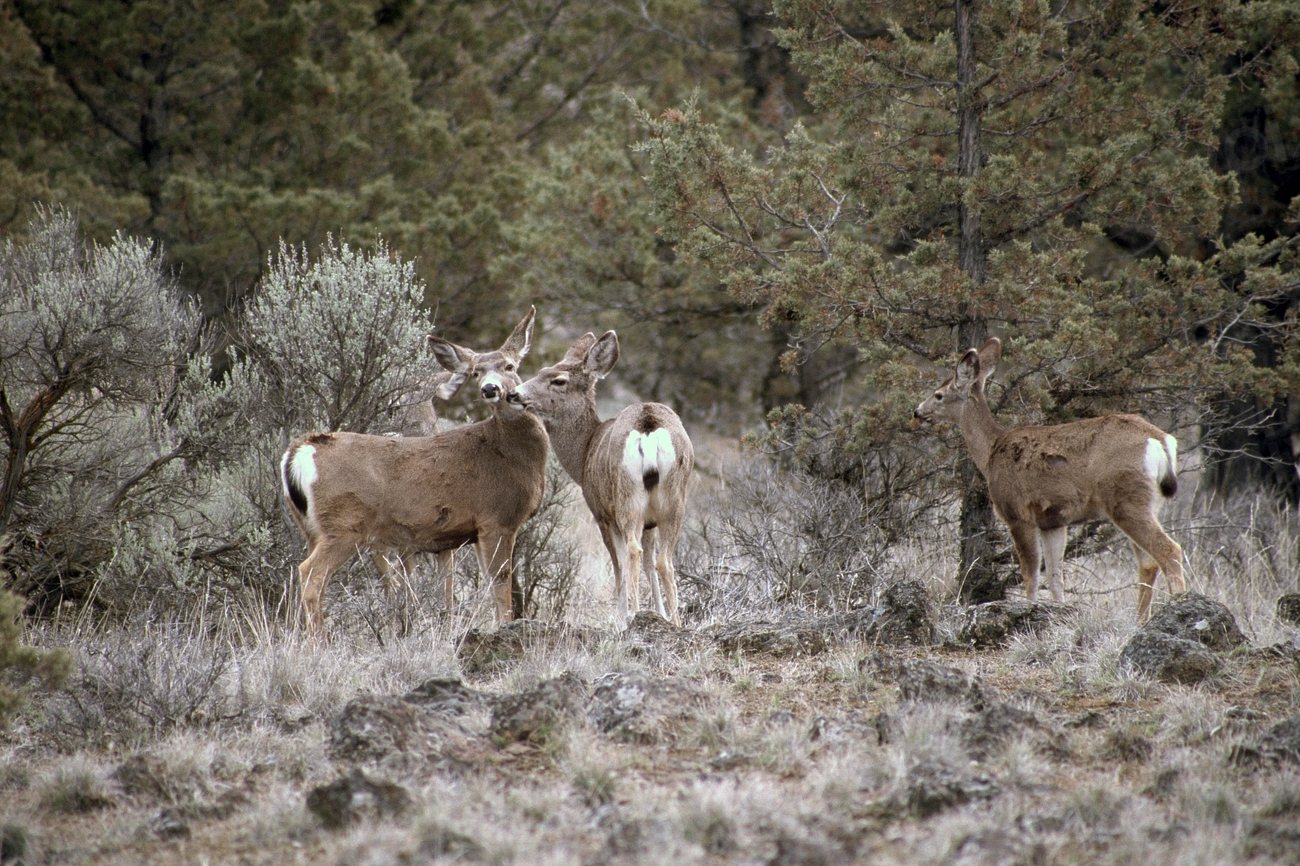
Mule deer are the animal you are most likely to meet, and the one that matters most for safety. They are large, with oversized ears and a black-tipped tail, and they browse the meadow edges and campground margins from dusk through the night into early morning. In summer the does are often with fawns; in autumn the bucks carry full antlers and are less cautious during the rut.
The park road, Highway 63, and Highway 12 outside the park see collisions with deer every year, almost all of them after dark. The rule is simple: after sunset, drive slowly, scan the shoulders, and assume that where you see one deer there are two more. A deer standing still in the headlights will often bolt across the road rather than away from it. This is the reason we treat the night drive back from a stargazing session as the most dangerous part of the evening.
Ravens and the birds of the rim
The common raven is the park’s most visible bird and its most intelligent. Ravens patrol the viewpoints and parking areas all day, watching for dropped food, and they are wonderful to observe: they play in the updrafts along the rim, tumble in pairs, and call in a vocabulary that ranges from croaks to bell-like notes. They will also open an unzipped pack or a cooler in seconds, so keep food closed.
At dawn the forest along the rim is loud with Steller’s jays, Clark’s nutcrackers and the drumming of woodpeckers. Violet-green swallows and white-throated swifts hunt over the amphitheatre through the day. In the evening, listen for the great horned owl in the ponderosas near the campgrounds and watch for bats, of which the park has more than a dozen species, working the meadow edges at last light. On the highest ridges in summer, keep an eye out for the flash of a peregrine falcon.
How and when to watch
The pattern is the same for almost every species on the plateau: be out at first light or in the last hour before dark, move slowly, and let the animals come to you.
- Best hours: the half hour before sunrise until about 8 a.m., and from an hour before sunset until full dark.
- Best places: the meadows along the park road between the entrance and Sunset Point, the open flats near Rainbow Point, and the campground edges at dusk.
- Best method: drive the scenic road slowly with the windows down, stop at pull-outs, switch the engine off and wait ten minutes.
- Best behaviour: stay at least 25 yards (23 metres) from any animal and far more from a mother with young, never feed anything, and keep dogs leashed and away from prairie-dog colonies.
Larger predators live here too. Mountain lions and black bears roam the plateau but are almost never seen; coyotes are common and their evening chorus from the meadows is one of the sounds of a Bryce night. Elk have moved into the higher forests in recent decades and can appear at Rainbow Point in the early morning. Great Basin rattlesnakes are rare at this altitude but present in the warmer canyons below the rim, so watch where you place your hands on rocks in summer.
One September dawn we stopped at a pull-out south of the entrance with coffee going cold in the cup holder. Frost on the sage, a prairie dog sentry already up on its mound, and then, at the far edge of the meadow, a line of pronghorn moving out of the trees into the first light, unhurried, their white rumps glowing. Nobody else was on the road. It cost nothing but an early alarm, and it is the picture of Bryce we carry most vividly. The hoodoos are the reason people come. The meadows at dawn are the reason we come back.