
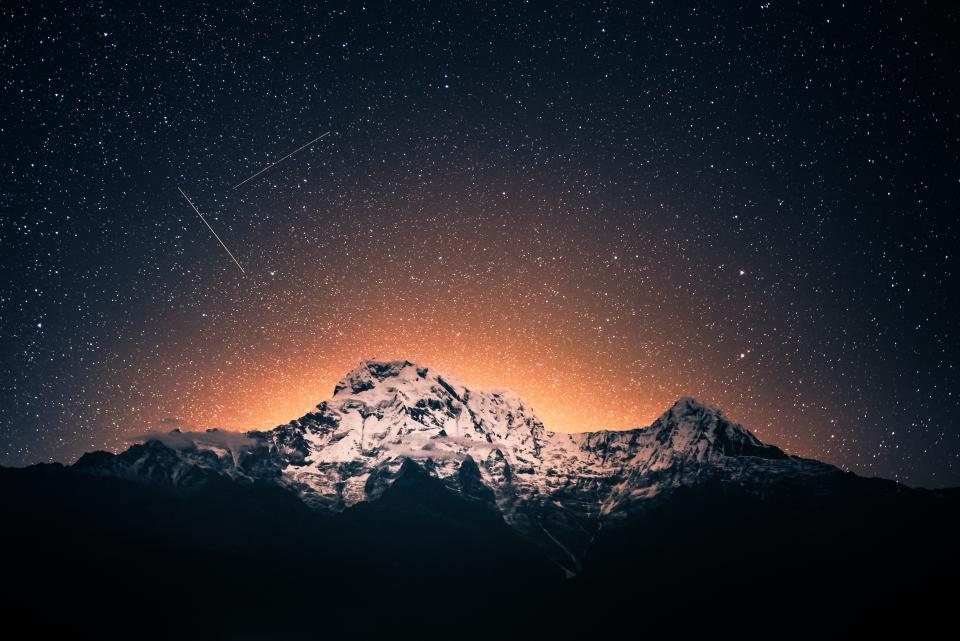
You do not need a telescope, a star-tracker or even binoculars to have a remarkable night at Bryce Canyon. You need a clear sky, a dark week and a decent place to stand. Everything else is patience. We have spent many nights on the rim with nothing more than a blanket and a thermos, and this is what we have learned about picking the right night and the right spot.
Table of Contents
When the Milky Way is worth staying up for
The bright, dense part of the Milky Way, the galactic core in Sagittarius and Scorpius, is what most people mean when they say they want to “see the Milky Way.” It is not visible all year. From the northern hemisphere the core rises in the pre-dawn hours in March, climbs earlier each week through spring, dominates the southern sky all evening from June to August, and sinks below the southwestern horizon by late October. From November to February the core is on the far side of the sun and you will only see the fainter winter arm overhead.
At Bryce the sweet spot is late May to mid-September. In June and July astronomical darkness does not arrive until around 10:45 to 11 p.m., so a summer session is a genuinely late night. By September full darkness comes before 9 p.m., the nights are crisper and the core is already high in the south at dusk. We think early September is the best compromise between comfort and spectacle.
The moon decides everything
The single most important planning decision is the lunar phase. A full moon at Bryce is beautiful in its own way, the hoodoos glow silver and you can walk without a headlamp, but it erases the Milky Way completely. The best window runs from about four days before new moon to four days after. A thin crescent that sets soon after dusk is fine; a first-quarter moon that hangs in the sky until midnight is not.
Two things help if your dates are fixed. First, the moon rises roughly fifty minutes later each night, so in the days after full moon you get a dark window in the early evening before moonrise. Second, in the days before new moon the moon does not rise until the small hours, so a midnight session is dark even though a dawn one is not. Check moonrise and moonset times for the park, not a distant city, since the eastern horizon here is the Paria Valley and the moon appears earlier than you might expect.
Where to stand along the rim
The main amphitheatre viewpoints are all reachable in a few minutes from a parking area and all face east or southeast, which is exactly where the Milky Way core rises in summer. Each has a different character after dark.
- Sunset Point: the easiest, closest to the lodge area and campgrounds, with a wide flat rim and Thor’s Hammer below. It also gets the most people.
- Inspiration Point: three stacked overlooks with a short climb to the upper one. Fewer people, a broader sky and the whole amphitheatre laid out beneath you.
- Bryce Point: the highest of the main viewpoints at about 8,300 feet (2,530 metres), with a railed platform that juts out over the drop. Wind-exposed, superb.
- Paria View: a smaller overlook down a side road, facing south. Quiet, and the best of the four for catching the core low over the horizon in early summer.
Farther south along the 18-mile (29-kilometre) scenic drive, Rainbow Point at 9,115 feet (2,778 metres) is the highest and darkest spot in the park, but it is a 40-minute drive from the entrance and the road is narrow at night. Save it for a second visit.
Getting your eyes to do the work
Human night vision takes twenty to thirty minutes to reach its full sensitivity, and a single glance at a white phone screen resets it. Arrive before full dark, sit down, and resist the urge to check the time. If you must use a light, cover it with red film or set the screen to its lowest red-tinted mode. Once adapted, look slightly to one side of a faint object rather than directly at it; the edge of your retina is more sensitive to dim light. This “averted vision” trick makes the Andromeda Galaxy, a faint oval in the northeast on autumn evenings, pop into view.
Binoculars, if you happen to own a pair, are the one piece of gear worth carrying. Even a small pair turns the Milky Way into a field of individual stars and shows the moons of Jupiter as tiny points beside the planet. But we have had our best nights with none at all, lying on our backs, watching satellites cross and meteors flare.
Practical comfort at 8,000 feet
The rim is cold at night in every month of the year. In July, when the afternoon reached 80 degrees F (27 degrees C), we have watched the thermometer drop to 45 degrees F (7 degrees C) by midnight. Bring more layers than seem reasonable, a hat, gloves, and something to sit or lie on so the ground does not steal your warmth. A hot drink makes the difference between an hour and three.
Stay behind railings and on marked paths. The rim edges are crumbly limestone, the drop is hundreds of feet, and the dark makes distances deceptive. Walk out on the paved rim trail rather than cutting across unmarked ground, and keep a dim light handy for the path back to the car. Mule deer are common along the road at night, so drive out slowly.
A simple night, done well
Our routine is now almost a ritual: dinner early, a short nap, then out to Inspiration Point by 10 p.m. with blankets and a flask. We give it half an hour before we start looking for anything in particular. By eleven the core of the Milky Way stands over the hoodoos like smoke, and by midnight we have usually counted a dozen meteors and lost track of the hour. No equipment, no expertise, no cost beyond the park entry fee. It remains one of the best nights out we know.